Understanding Ourselves: The Anglican Faith

The Anglican Communion.
Its structure
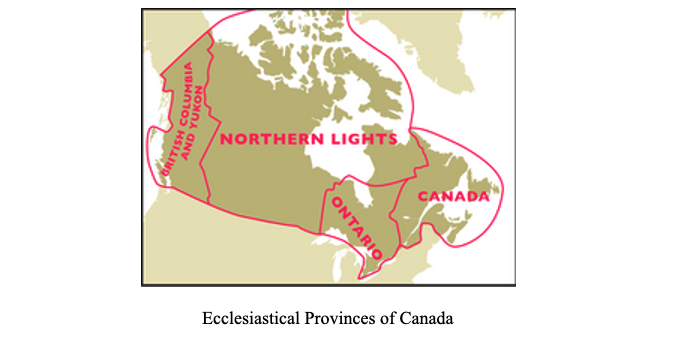
Our Diocese of Athabasca is part of a world-wide communion of dioceses. We are one of 10 dioceses in the Province of Northern Lights (geographically comprising of Alberta, Saskatchewan, Manitoba, parts of Western Ontario, the Northwest Territories and Nunavut).
Our province is then one of four provinces in the Anglican Church of Canada. The Anglican Church of Canada is then a member of the Anglican Communion.
The worldwide churches stay connected through four bodies or offices (traditionally called the "Instruments of Communion”:.)
1.) The Archbishop of Canterbury: A focus of unity and historically represents the communion to the world. The archbishop does not govern the Anglican Church of Canada or other independent member churches, but is the Primate of All England.
2.) The Lambeth Conference: A gathering of bishops from across the Communion for consultation and discussion, typically meeting every 10 years. Any recommendations must be adopted by member provinces to become canonical (lawful).
3.) The Primates’ Meeting: A meeting of the senior leaders of the member churches. A primate is the representative bishop of a province or nation (the Anglican Church of Canada and The Episcopal Church (United States) have national primates, the rest all have provincial primates); the title may be archbishop, presiding bishop or another designation.
4.) The Anglican Consultative Council: A representative body including bishops, clergy and lay people, supporting shared mission and cooperation.
The Anglican Communion Office provides administrative and coordinating support for this international work.
Where the authority sits
Each diocese establishes its own constitution, church laws (canons) and decision-making processes. It selects its leaders and regulates matters such as worship, ordination and discipline within its own jurisdiction.
That means a decision made in England does not automatically apply in Canada, Nigeria or Australia. Likewise, a worldwide Anglican gathering cannot simply rewrite the rules of every member church.
Anglicans are held together by shared foundations: Scripture, the historic creeds, baptism and the Eucharist, ministry through bishops, priests and deacons, and a common inheritance of worship shaped by the Book of Common Prayer. Worship styles and theological views nevertheless vary considerably.
Disagreements can be difficult
Because there is no worldwide authority that can impose a final settlement, disagreements can strain relationships between churches. Churches may limit cooperation or declare themselves out of communion with others while continuing to identify as Anglican.
To work out disagreements, Anglicans meet in gatherings known as Synods (from the Greek for “together-way”). Every diocese, province, and nation has its Synods at which policies are debated and adopted by representative bishops, clergy, and lay people. This has led to an expression of “episcopally led and synodically governed.”
- Episcopally led: Bishops provide spiritual, pastoral and teaching leadership.
- Synodically governed: Bishops, clergy and lay representatives share in formal decision-making through synods.
Bishops also have specific governing powers, so the distinction is not absolute (for example, bishops can over-rule synod decisions or make their own canons (laws) for the diocese as they see fit). The phrase attempts to capture a balance between leadership by bishops and representative church government.
This October, the dioceses of Qu’Appelle, Rupert’s Land, Ottawa, Calgary, Edmonton, Saskatoon, Huron, and Athabasca are all planning to have diocesan synods. The provincial synod for Northern Lights is scheduled for spring 2027, and the national synod for spring 2028.
May you be blessed as you join with the rest of the world-wide Anglican Communion in prayer, worship, and decision-making.
+David