Understanding Ourselves: The Anglican Faith

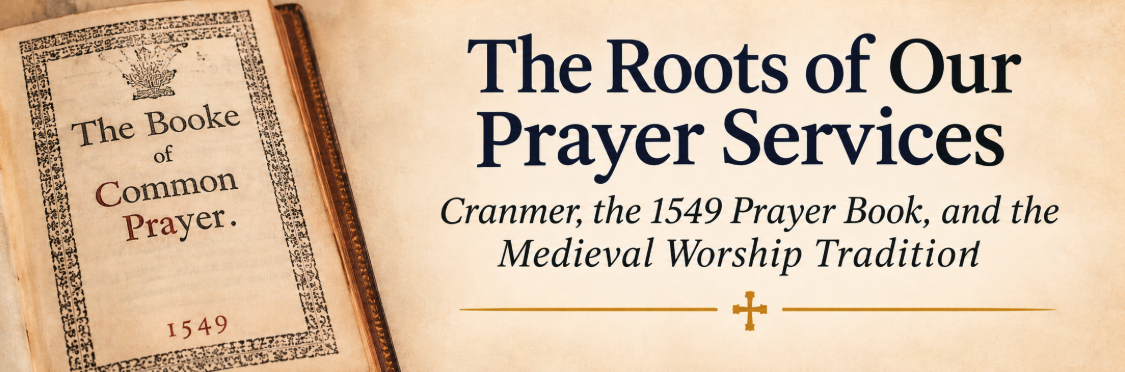
Where did our Morning, Evening, and Holy Communion prayer services come from (part 2)?
3 Cranmer and the first Prayer Book of 1549
The first Book of Common Prayer appeared in 1549 under Edward VI. Its composition is principally associated with Thomas Cranmer, Archbishop of Canterbury. It was published in English, not Latin (very radical), and established the first form of the Prayer Book tradition. 5
Cranmer worked with inherited Latin services and contemporary proposals for reform. Alongside medieval English rites, a revised Roman breviary and European reforms were included (details next section). 5
The 1552 version substantially altered the Eucharistic order published in 1549. There was considerable continuity with medieval worship alongside deliberate doctrinal and structural change.
4 Medieval English worship and the Use of Sarum
The principal medieval English source was the Sarum Rite (more properly called the Use of Sarum or Use of Salisbury),the local liturgical variant of the Roman Rite developed at Salisbury Cathedral and associated with the Diocese of Salisbury.
It was established by Saint Osmund in the late 11th century and refined by Richard le Poore in the 13th century after the diocese moved from Old Sarum to New Sarum (Salisbury). It served as the primary form of Christian public worship, including the Mass and Divine Office, for the Diocese of Salisbury and later became the dominant rite throughout most of England, Wales, Ireland, and parts of Europe until the English Reformation. While it was dominant, there were other rites and forms commonly used, and the first Prayer Book replaced the plurality of forms being used in the British Isles with a common English order. 6
Several kinds of service books were combined, in various fashions and degrees, into the Prayer Book. The Missal (a book containing the service of Holy Communion, or Mass, for the entire year) supplied the Eucharist, including its seasonal prayers and readings. The Breviary (a book containing the prayers, hymns, psalms, and readings for the canonical hours, up to eight times per day (matins (between midnight and 2 am), lauds (sunrise), prime (an hour after lauds), terce (third hour after sunrise), sext (sixth hour after sunrise), none (ninth hour after sunrise), vespers (sunset), and compline (bedtime) converting to our clock, a typical day would be prayed between midnight and 2 am, then 5 am, 6 am, 9 am, noon, 3 pm, 6 pm, and 9 pm) were combined into the daily offices of Morning Prayer, Noon prayer, Evening Prayer, and Compline. Diverse manuals and Pontificals (a book of ceremonies to be done by a bishop) provided pastoral and episcopal rites, including baptism, marriage, burial, confirmation, and ordination. Each of these had their own history of formation and continuation.
Morning and Evening Prayer show the process clearly. Morning Prayer combines material from Matins, Lauds, and Prime; Evening Prayer combines material from Vespers and Compline. This inheritance explains the order of familiar canticles. The Benedictus belonged to Lauds, the Magnificat to Vespers, and the Nunc Dimittis to Compline. 7
A particular prayer can reveal a more precise genealogy than an entire service. For example, “Lighten our darkness,” retained in Evening Prayer, passed into Common Prayer via the Sarum Compline from the Gelasian sacramentary tradition (dating to around A.D. 650). The evening collect for peace has a similarly ancient Latin ancestry, dating to around A.D. 494. 8
- Society of Archbishop Justus, “The 1549 Book of Common Prayer,” introduction and reproduced text.
- The National Archives, “Book of Common Prayer”; Society of Archbishop Justus, “The 1549 Book of Common Prayer.”
- Church of Ireland, The Study of Liturgy, part 2, “The derivation of Morning and Evening Prayer,” printed p. 7, PDF p. 13.
- Church of Ireland, The Study of Liturgy, commentary on the Evening Prayer collects, printed pp. 13–14, PDF pp. 19–20.
+David